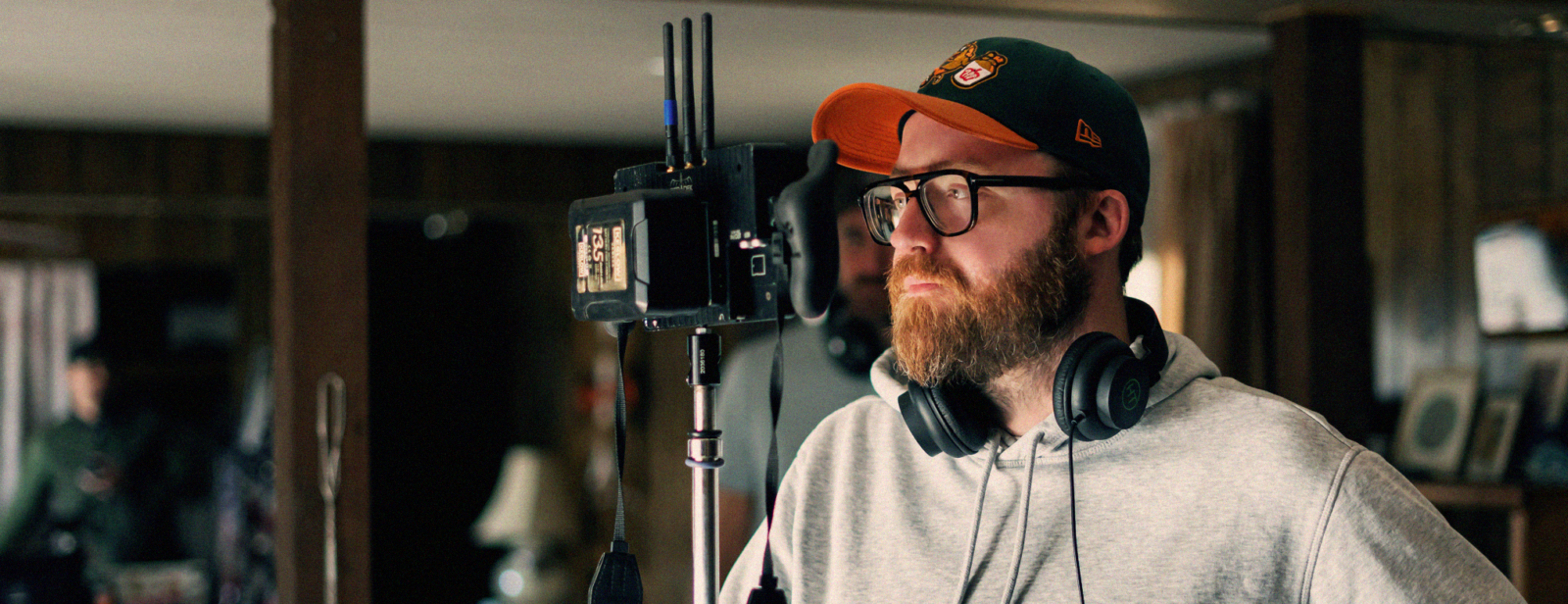


Every filmmaker’s path is different, so we asked David Drake about his unconventional route from photographer to debut feature filmmaker, a journey that took him through music videos, self-funded shorts, and BFI NETWORK support. His experience with BFI NETWORK’s Project Lab, Early Development Fund, and Short Film Fund illustrates how targeted support can accelerate a filmmaker’s development, providing not just funding but crucial industry connections and the confidence to navigate the complex world of feature film production. Read on for his candid reflection on persistence, patience, and the realities of bringing a first feature to life.
Short to Feature
I turned thirty-nine on the set of my debut feature film earlier this year. It took eighteen years of zigzagging and manoeuvring to finally reach this goal, so this is a brief reflection on that journey.
A quick summation of my background: I grew up in a small town called Poughkeepsie, which is about 80 miles from New York City. I come from a working family, my mom and stepdad were nurses, my dad delivered produce to restaurants. I have a high school degree, and that’s it. I met my wife Gabby when I was nineteen. Within a few short years we got married, started a family, and moved to the UK (she’s from Norwich).
Up until this point I had worked as a window cleaner, machinist, salesman, bartender, etc. I had a strong interest in writing (thanks Dad), filmmaking, and photography, so I pursed all three as hobbies. By the time I was twenty-six years old, photography was my career. The trajectory went something like this: family portraits, then weddings, then a local newspaper, then product photography, then advertising, and then album covers for record labels — which became my niche.
I was moonlighting for many years while maintaining a full-time job at a product photography studio. I left that job when I turned thirty in order to start freelancing full time. This was only possible because I got a good amount of exposure (and compensation) from two neon album covers I shot for The 1975.
This was when I decided to finally try my hand at filmmaking. Time had always been an issue, but now I was working for myself without a viable excuse. I had directed a dozen or so music videos over the years, so I had a rough idea how to logistically pull together a short film project. Through my music video work, I had met camera ops, sound mixers, and a few actors.
So I wrote a script, shared it with my friends, modified my DSLR, and found a location. I only had £350, which wasn’t enough to pay my collaborators, but it was enough to make sure that the food on set was plentiful and of good quality. It doesn’t matter if your film is no-budget or fully funded: never, ever skimp on food. People will occasionally work pro bono if they are passionate, but not on an empty stomach.
I made four self-produced short films over the next two years. It became a pattern — while I was finishing one film, I’d be starting on the next. My shorts got into festivals, one was picked up by NOWNESS, and I even won a festival (and was flown out to Catalonia to accept the prize). I was hooked on the process. I truly believe that filmmaking (like all forms of artistic expression) becomes a compulsion. If you’re making and sharing films over and over again without expectations, you’re doing it right. Recognition or success (in whatever forms they might take) should emerge as a consequence of the work, not as a motivation to do it.
In 2018 I attended a BFI NETWORK event at my local Picturehouse in Norwich. This was my first time hearing about their film funds. It was a huge revelation for me. I decided that I would educate myself about the wider industry and attempt to work within it. I made applications for every BFI NETWORK initiative I was eligible for. This is how it played out:
- Project Lab at the Cambridge Film Festival (2018)
- Early Development Fund (2019)
- Short Film Fund (2019)
During the production of Left Over, my BFI NETWORK Talent Executive (Tom Wightman) not only gave me a steady stream of encouragement and constructive notes, but he also introduced me to development execs, producers, and a story editor. On the whole, though, the experience was less of a handholding exercise and more of a shove out of the nest. You need to take criticism, build a team, and survive the pressure cooker of production (with all the exacting schedules and expectations from pro cast and crews). In terms of personal development, this was my most important takeaway.
By now I was maintaining a spreadsheet of UK based producers that I wanted to work with. I found many of them via festival and lab websites. This is how I met Helene Sifre and Sam Bank (of Braintrust). I sent a cold email to Helene after finding her profile on a Berlinale Talents directory. She was in the process of producing a BBC & BFI film called Blue Jean (which would go on to secure BIFA wins and BAFTA nominations). Much to my surprise, Helene and Sam watched my shorts and invited me to a meeting in London. I didn’t know at the time, but this meeting would change my life.
Braintrust commissioned me to write my debut feature a few weeks later. It was my first paid writing gig, and I wrote the script during the first and second COVID lockdowns. After handing it in, I was under the impression that I’d be shooting the feature in no time at all, but this was a little optimistic (to say the least). The process actually took five whole years from start to finish.
Turns out putting a feature together is not dissimilar to building a house of cards (outside in the elements). You need to carefully stack up all the cards, all while the wind is blowing. If your main actor drops, a key piece of financing pulls, a deal expires, or an application is denied — then the whole tower crumbles. So you pick up the pieces, start again, and again after that, ad infinitum.
This happened to us many times, but we persevered. Patience and persistence is the key virtue of filmmakers who somehow stick out development hell. During the five year stretch it took to get Dead Letters off the ground, I kept myself busy with more scripts, producing short films for friends, and prepping every aspect of the feature I could do on my tod, all while carving out a living and raising a family.
Thanks to the tireless work of Sam, Helene, and Juliet Berman (who joined in 2024), the stars finally aligned around Christmas of last year. I moved away from my wife and daughter for the duration of prep and production, which was very tough for all of us. I was in New Mexico for nearly three months, and I came back to London for the edit. We’re now picture locked, but still working the score, sound, and grade.
In summation, if I were to give any advice, it would be to figure it out as you go. Don’t wait for perfect circumstances or permission. There are so many obstacles in life as it is, don’t give your brain the time to list them all out. Start small. Make and share your films, then repeat. If your goal is to make a feature film, an authorial voice and demonstrable personal agency will help punch your ticket. Also luck.
David Drake
David Drake (b. 1986, New York) is a self-taught American filmmaker and photographer based in the UK. His debut feature Dead Letters shot in early 2025 and was produced by Helene Sifre, Sam Bank, and Juliet Berman. The film stars three-time Emmy winner Margo Martindale, Stephen Root, Cole Sprouse, Oscar nominee Yalitza Aparicio, and Oscar recipient Wes Studi. David's BFI Network supported short film Left Over stars Chloe Pirrie and Ian Hart, and was selected as a Vimeo Staff Pick in 2022. David’s photography has been published widely and has featured in publications like Teen Vogue, Creative Review, Nero, and Clash. He has worked with artists like The 1975, Glass Animals, Django Django, Tom Grennan, IDER, and Kele Okereke. In 2017, the album cover he shot for The 1975 was nominated for an ‘artwork’ Grammy.